
The provincial minimum for a new Part 3 multi-unit residential building in British Columbia is Step 2 of the BC Energy Step Code plus Zero Carbon Energy Level 1. Step 3 applies only where a local government has adopted it by bylaw, and Step 4 is voluntary almost everywhere. Step 4 still earns a $2.50 per square foot FortisBC capital incentive, and Step 3 and Step 4 both earn the maximum CMHC MLI Select energy points via the BC Step Code shortcut. The financial argument for Step 4 is the rebate, not the points.
This guide is for developers, architects, and energy modellers working on rental MURBs in the BC Interior. It walks through what Step 3 and Step 4 mean in practice, how the BC Step Code shortcut to CMHC MLI Select works, and how FortisBC Commercial New Construction pays out. The numbers throughout are pulled from real BC Interior rental projects where EcoSeal supplied the closed-cell spray foam.
What the code actually requires
The 2024 BC Building Code took effect on March 10, 2025. The provincial minimum for a new Part 3 permit is Step 2 plus Zero Carbon Step Code Energy Level 1. Step 3 is not mandatory province-wide. It applies only where a local government has adopted it by bylaw, so check the bylaw in your municipality before assuming anything.
That makes Step 3 a choice, and usually a good one. Declaring Step 3 maps to the maximum 50 CMHC MLI Select energy efficiency points through the BC Step Code shortcut covered below, and it is the cheapest route to them.
The argument for spray foam on a 4-storey wood-frame MURB goes further than points. It is Step 4 declaration, the FortisBC CNC capital incentive, and a defensible airtightness number that holds up at occupancy testing.
What Step 4 actually requires
Step 4 sets two performance metrics: TEDI (thermal energy demand intensity) and TEUI (total energy use intensity). The targets vary by climate zone and the residential vs commercial split of the floor area. For a 4-storey MURB in CZ5, Step 4 TEDI is 21 kWh/m²/yr. For a 6-storey MURB in CZ4 or CZ5 the target lands around 20 to 21 kWh/m²/yr after the residential/commercial floor area weighting.
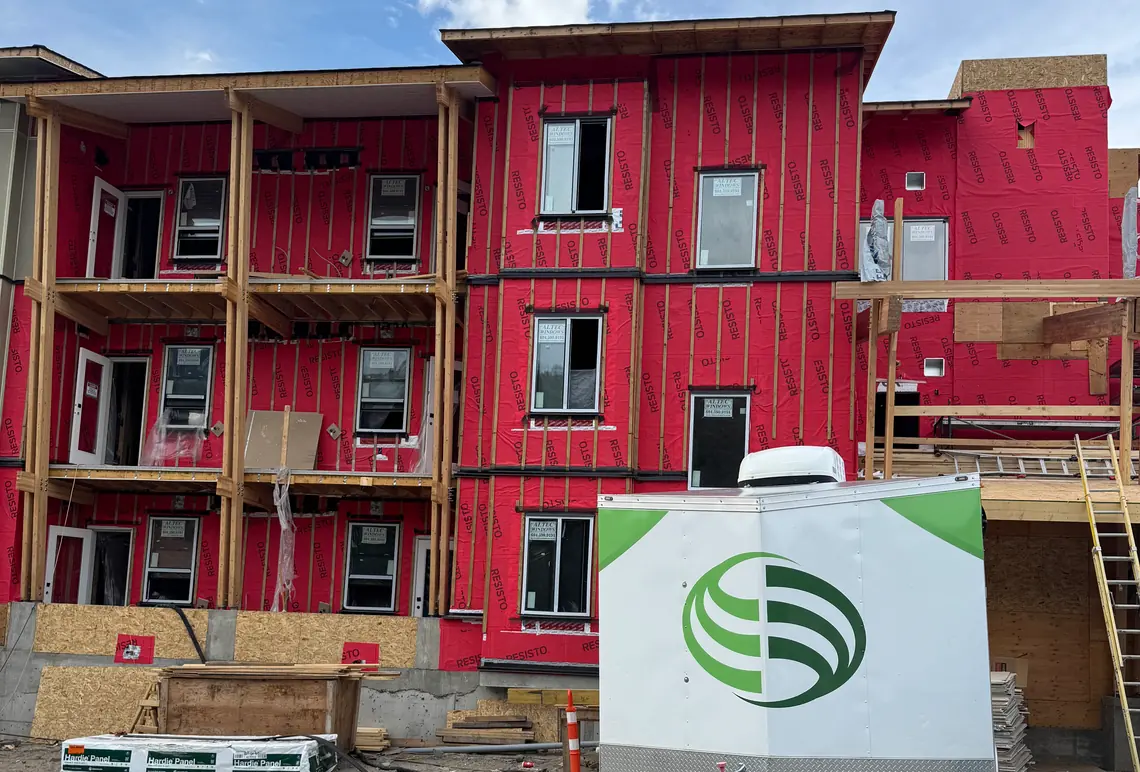
An 84-unit 4-storey wood-frame rental building in the Okanagan Valley that EcoSeal insulated shows what the envelope can do. TEUI came in at 94 kWh/m²/yr against a Step 3 target of 119, which beats the target by 21 percent. The blower door measured 0.20 L/s/m² facade at 75 Pa.
A 140-unit 6-storey wood-frame MURB in the BC Interior that EcoSeal also insulated passes Step 3 by a 4.8 kWh/m²/yr TEDI margin but fails Step 4 by 8.8 kWh/m²/yr. Five-inch SPF in the cavity closes about 1.5 kWh/m²/yr of that gap. Reaching Step 4 on a 6-storey building also needs exterior continuous insulation of 2 inches or more plus an HRV upgrade to 85%+ SRE.
The 4-storey vs 6-storey distinction matters. Wall-to-floor area ratio is lower on a 6-storey building (0.378 vs 0.424 on the 4-storey), so wall improvements deliver less TEDI per m² of floor area. About 46% of that building's wall heat flow goes through thermal bridges that cavity SPF cannot touch.
The BC Step Code shortcut to MLI Select
CMHC MLI Select scores up to 50 energy efficiency points. The points map to NECB 2020 percentage improvement over the reference building.
| NECB 2020 Direct Route | EE Points |
|---|---|
| Level 1 — 25-49% better than reference | 20 |
| Level 2 — 50-59% better | 35 |
| Level 3 — 60%+ better | 50 |
The BC Step Code shortcut, confirmed in the CMHC Required Documentation Guide third-party building standards table, is the practical alternative for any BC project. Step 2 maps to Level 1 (20 points). Step 3 and Step 4 both map to Level 3 (50 points).
The documentation submitted to CMHC is the BC Part 3 Energy and Zero Carbon Design Checklist, which replaces the separate NECB attestation form. No NECB 2020 reference model is required for the energy points if you take the Step Code route.
What 50 points actually buys
CMHC MLI Select premium discounts and amortization extensions are tiered:
- 50 points = 10% premium discount + 40-year amortization
- 70 points = 20% premium discount + 45-year amortization
- 100 points = 30% premium discount + 50-year amortization
Energy alone caps at 50 points. To reach the 100-point tier a project needs to stack affordability and accessibility points. The CMHC affordability cap is 100 points standalone (10% / 15% / 25% of units at 30% of regional median renter income, plus a 30-bonus for a 20-year commitment). The accessibility cap is 30 points for new construction (20 points for 15% accessible per CSA B651-23, 30 points for 100% universal design or Rick Hansen Gold).
A common hybrid stack via the Step Code shortcut: 50 energy points + 20 accessibility points + 50 affordability points = 120, capped at 100. Full 30% discount, 50-year amortization.
FortisBC Commercial New Construction
FortisBC's CNC program pays $2.50 per square foot of conditioned floor area on a Step 4 MURB declaration. A Step 3 declaration earns zero from this capital incentive. The program also pays 50% of energy modelling cost up to $15,000 and a mid-construction airtightness rebate up to $5,000.
On the 4-storey Okanagan Valley rental building (62,660 sq ft) the available stack was:
- Capital incentive at Step 4: $156,650
- Energy modelling rebate: $15,000
- Airtightness rebate: $5,000
- Total available: $176,650
The total captured was $15,000, the energy modelling rebate. The other $161,650 was left on the table. The building beat its Step 3 TEUI target by 21 percent, but it was declared Step 3 on the Appendix B checklist, and the project was never enrolled in CNC before above-ground construction began. Both are program requirements. Both were missed.
This is the gap EcoSeal's building performance advisory service exists to close.
The four CNC process gates in order:
- Pre-construction enrollment before above-ground construction begins. Sign the FortisBC incentive estimate letter.
- Step 4 declaration on the BC Step Code Appendix B Section C checklist.
- Above-ground construction attestation plus a site report.
- Final inspection plus all energy conservation measures installed as modelled.
The mechanical side of CNC also matters. The makeup air unit must be condensing technology — industry convention is 90%+ AFUE. The Engineered Air FW43/DJ series at approximately 80% AFUE is non-condensing and disqualifies the rebate even if everything else is in order. Condensing options include the Engineered Air DG Series, Greenheck DGX (92%), and Reznor YDMA (90%+).
Where FortisBC CNC is not available
The CNC program requires gas service for the building's primary heating and DHW end uses. Municipalities that have adopted Zero Carbon Step Code Energy Level 3 or 4 require electric primary heating and electric primary DHW, which eliminates both end uses. CNC is structurally unavailable on new Part 3 MURBs in:
- Maple Ridge — EL-3 effective July 1, 2025; EL-4 scheduled September 2026
- Victoria — EL-4 effective July 1, 2024 for Part 3 4-6 storey
- Vancouver, Burnaby, New Westminster, Nanaimo, Saanich — EL-3 or EL-4 active
The BC Interior — Vernon, Kelowna, Salmon Arm, Kamloops — is currently baseline provincial EL-1 only. Gas service is permitted. CNC is available. Penticton has discussed bylaw adoption but enactment is unclear; verify before any project there.
What this means for the next building
If your next building is in the BC Interior and you can hit Step 4, the financial case is straightforward. SPF over batt and poly costs about $2,305 more per door at the same 4-storey spec. The FortisBC CNC capital incentive at $2.50 per square foot pays back about $1,865 per door. A 4-storey building also opens up about $50,000 to $77,000 in mechanical downgrade savings (heat pumps and DHW), which works out to $595 to $917 per door. Net position: the developer comes out $215 to $537 per door ahead before any MLI Select financing benefit.
Those mechanical downgrade figures are engineering estimates, not contractor quotes. Get quotes from a mechanical contractor before any pro forma uses them.
If your next building is in a Lower Mainland or Vancouver Island municipality at EL-3 or EL-4, FortisBC CNC is off the table. The argument for SPF on those buildings is airtightness, defensible Step 3 declaration, and the BC Hydro Whole Building Design custom incentive — which references buildings not subject to Step Code, so confirm with BC Hydro that a Part 3 MURB qualifies before citing it in a model.
How EcoSeal works on a Step Code project
We send a written spec letter to your energy modeller before the permit model is built. The model is only as good as what the contractor tells the modeller — if the drawings say batt and poly and we install SPF without communicating, the as-built report runs with batt and poly assumptions. The building outperforms the model and nobody knows by how much.
We test for moisture before every spray. We run density checks. We attend the Step Code Appendix B checklist signoff and we make sure the FortisBC CNC enrollment letter is signed before construction starts.
That is the gap between performance and rebate capture. Closing it is the work.
Sources
- BC Energy Step Code, Part 3 Checklist User Guide v3.0.1 — bcenergystepcode.ca
- FortisBC Commercial New Construction Participant Guide, July 2025 — fortisbc.com
- CMHC MLI Select Required Documentation Guide — cmhc-schl.gc.ca
- Building Envelope Thermal Bridging Guide v1.6 (BETBG)
- Occupancy energy model, 4-storey Okanagan Valley rental building (on file with EcoSeal, project anonymized)
- Stantec occupancy update, 6-storey BC Interior rental building (on file with EcoSeal, project anonymized)